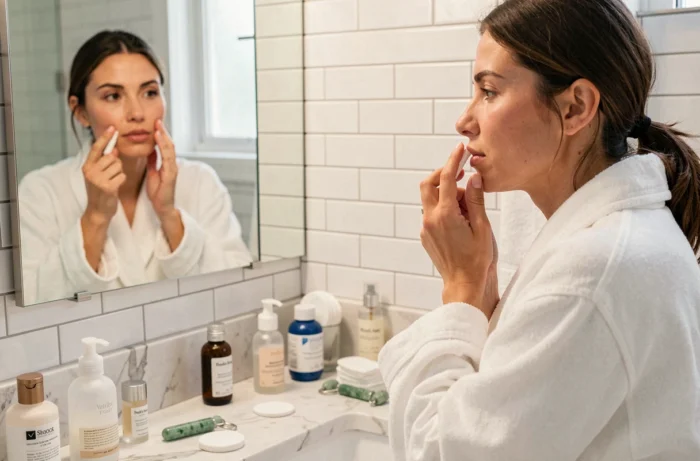
Your skin feels tight after your morning cleanse, or your complexion looks dull by midday despite the products you’ve applied. The issue rarely stems from the number of products used. It is more about the order of application, the choice of textures, and a few habits that most beauty routines overlook. This article details the concrete adjustments that change the visible results on your face, without multiplying the bottles.
Order of application for facial care: the texture rule that changes everything
Have you ever noticed that a serum seems less effective on certain days? The most common cause is a sequencing issue. An active ingredient applied at the wrong time in the routine penetrates poorly, or even forms a film that prevents the next product from working.
The principle is simple: apply textures from the most fluid to the thickest. Start with a floral water or toner, then the serum (watery, concentrated), followed by the moisturizer, and finally the sunscreen in the morning. Each layer prepares the skin to receive the next one.
This principle also applies in the evening. After makeup removal, a treatment serum (azelaic acid, niacinamide, retinol depending on your skin type) should be applied to clean, slightly damp skin. The night cream seals everything in. Reversing these two steps significantly reduces the penetration of the active ingredient.
To deepen your knowledge about suitable gestures and products, a useful resource: https://www.lebreakbeaute.fr/ offers regular content on facial and body care.

Adapting your beauty routine to your skin type rather than trends
Social media popularizes viral combinations of active ingredients, such as the azelaic acid and tretinoin duo spotted on TikTok. These combinations can work, but they are not suitable for all skin types. An active ingredient that is poorly tolerated causes more damage than an absent one.
Before adding a new product, identify your skin type (oily, dry, combination, sensitive) and its current state. Dehydrated skin is not the same as dry skin: the former lacks water, while the latter lacks lipids. The appropriate care differs completely.
Testing an active ingredient without damaging your skin
Introduce only one new product at a time. Wait two to three weeks before adding another. This delay allows you to spot any potential reactions (redness, breakouts, tightness) and clearly identify the culprit.
- Apply the new product every other night during the first week, then every night if tolerance is good
- Avoid combining two exfoliating actives (glycolic acid and retinol, for example) on the same nights until your skin has adjusted to each one separately
- Note the introduction date on the bottle to easily track the duration of the test
Patience in introducing actives protects the skin barrier, that lipid film that maintains hydration and blocks external irritants.
Makeup routine and complexion glow: prepare rather than correct
A foundation applied on poorly prepared skin emphasizes pores and oxidizes more quickly. The result looks artificial within a few hours. The solution does not lie in a more expensive makeup product, but in proper preparation beforehand.
Sufficient hydration before makeup smooths the skin texture. The cream should be fully absorbed (allow two to three minutes) before applying a primer or foundation. On still sticky skin, makeup slides and doesn’t hold well.
Lips and eyes: two areas that require distinct treatment
The skin around the eyes is four times thinner than the rest of the face. A product that is too rich can cause milia (small white cysts). Opt for a light gel or fluid texture, applied by tapping with the fingertip of your ring finger, the finger that exerts the least pressure.
For the lips, a balm applied in the evening (and not just when they are already chapped) maintains their suppleness. In the morning, a thin layer of balm under lipstick or gloss prolongs the color’s wear and prevents a cracked effect by the end of the day.
AI tools to personalize your skincare
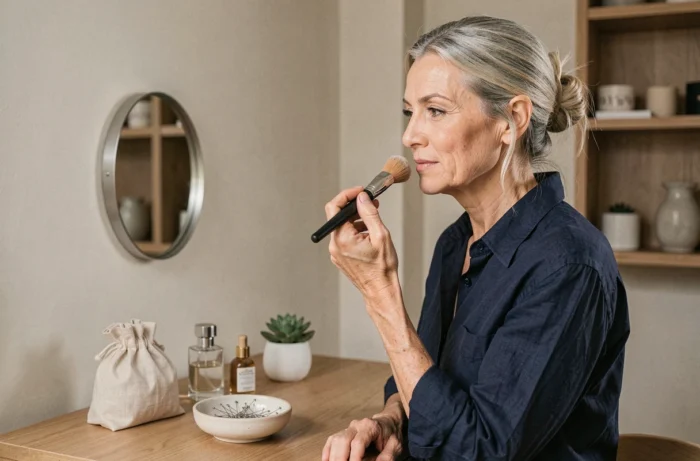
Beauty routines are no longer built solely by trial and error. According to a Criteo study published in August 2026, 36% of French consumers already use AI assistants for their beauty purchases. These tools analyze skin type, age, climate, and sometimes even photos to propose a tailored skincare protocol.
A Haut.AI survey from the same period indicates that nearly three-quarters of respondents believe that AI can make their routine simpler or more effective. The main interest is not to replace a dermatologist, but to filter compatible products with your profile before purchase.
In practical terms, these assistants help avoid mistakes in combining actives and reduce the number of unnecessary products in your bathroom. Fewer bottles, better chosen, is often more effective than an overloaded shelf.
Be vigilant about the composition of cosmetic products
European regulations on cosmetics are evolving. Several substances classified as endocrine disruptors or CMR (carcinogenic, mutagenic, reprotoxic) are subject to gradual restrictions within the European Union, with new deadlines set for 2026 and beyond.
- Read the INCI (International Nomenclature of Cosmetic Ingredients) list on the back of your products, even those labeled “natural” or “clean”
- Check the expiration date after opening (the small open jar symbol with a number on the packaging), especially for creams and serums containing vitamin C or retinol, which oxidize quickly
- Be wary of synthetic fragrances listed simply as “fragrance” or “parfum”: this mention can encompass dozens of undisclosed ingredients
Knowing the composition of your products prevents reactions and unnecessary purchases. A simple product with few well-tolerated ingredients is often better than a complex formula with an endless list.
The best beauty routine is not the one with the most steps, but the one you consistently follow with products suited to your skin. A gentle cleanse, a targeted active, proper hydration, and sun protection in the morning cover most needs. Everything else is personal adjustment.