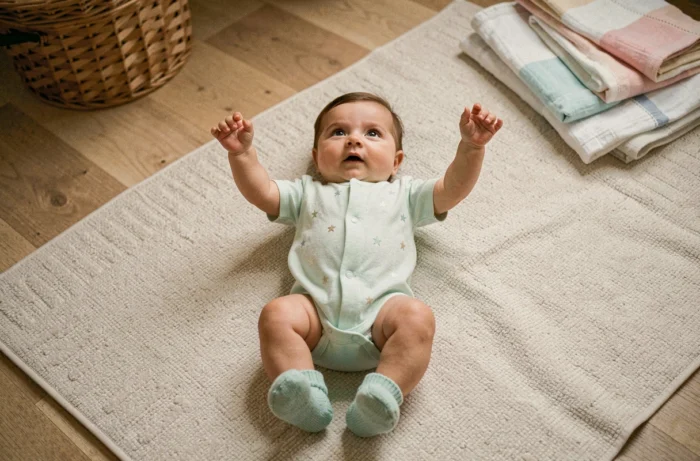
A 3-month-old bodysuit that gapes at the neck after two washes, a sleep sack too thick for the season, pants whose snap buttons last longer than a parent’s patience: we’ve all experienced these mishaps when dressing an infant. The choice of baby clothes is based on practical trade-offs between materials, fit, and safety, long before the question of style arises.
Baby Textile Safety: The Standards That Labels Don’t Show
We look at the size, color, sometimes the composition. Rarely the certifications. European regulations have recently evolved with the GPSR regulation, applicable since December 13, 2024, which strengthens traceability and safety information obligations on textile products intended for children.
Regarding chemical substances, controls target several at-risk families in baby clothing: azo dyes, phthalates, formaldehyde, and PFAS. These compounds can be present even in seemingly natural fabrics if the manufacturer has not tested their batches.
There are two reliable markers to help navigate this. The OEKO-TEX Standard 100, Class I certification guarantees that the textile has been tested for harmful substances in contact with infants’ skin. The GOTS (Global Organic Textile Standard) label covers both the organic cultivation of the fiber and the processing conditions. When you spot one of these two logos, you know that the garment has passed an independent check.
A common point of non-compliance appears frequently in European product alerts: cords and ties at the neck and head. The EN 14682 standard strictly prohibits them on clothing intended for young children. Before purchasing a hood or adjustable collar, check for the complete absence of free cords.
Cotton, Wool, Synthetic: Choosing the Right Material for the Season
Cotton remains the default choice, and for good reasons: it absorbs moisture, limits irritation, and withstands repeated washes. For items worn directly against the skin (bodysuits, pajamas), certified organic cotton reduces exposure to chemical residues from cultivation and dyeing. Today, there are accessible ranges on the baby category of Bébés Fringueurs, which allow for easy comparison of compositions.
Merino wool has gained ground in newborn clothing. It regulates body temperature better than cotton in winter while remaining breathable. Feedback varies on this point: some babies tolerate fine wool directly against their skin very well, while others need a cotton bodysuit underneath.
Synthetic materials (polyester, elastane) are not to be systematically banned. They provide elasticity in pants or overalls, making dressing easier. However, they should be avoided as the main layer against the skin, especially in hot weather, because they retain heat and sweat.
Sleep Sack and Layering: Dressing Baby for Sleep
The sleep sack has replaced the blanket in most safe sleep recommendations. Its thickness is measured in TOG, a unit that indicates the thermal resistance of the fabric.
- In summer or in a room heated above 22 °C, a light TOG (around 0.5 to 1) is sufficient, paired with a short-sleeved bodysuit.
- In autumn and spring, a medium TOG (between 1 and 2.5) with long-sleeved pajamas covers most situations.
- In winter, when the room drops below 18 °C, a higher TOG (2.5 to 3.5) combined with pajamas and possibly a bodysuit underneath ensures a warm night.
Adapting the sleep sack to the room temperature, not the calendar season, avoids overheating, which is a risk factor during infant sleep. A thermometer in the room remains the best ally.
To check if a baby is too hot or too cold, touch their neck or chest, not their hands or feet (which are often naturally cool). If the neck is sweaty, remove a layer of clothing.
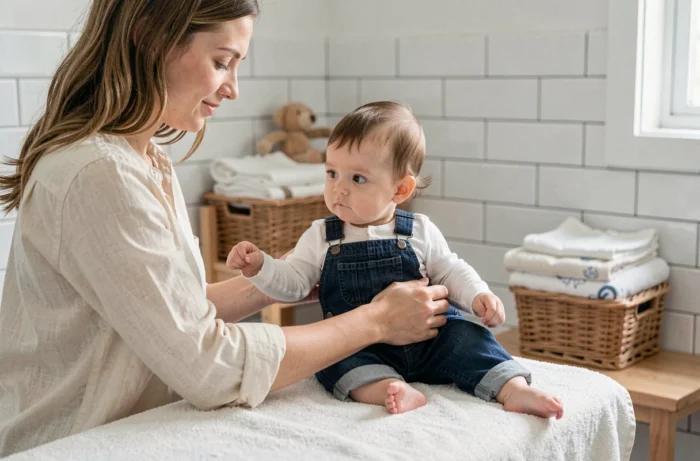
Size and Fit of Baby Clothes: Anticipating Growth Without Stocking Up
Baby clothing sizes vary from brand to brand, sometimes significantly. A 3-month size from one manufacturer may correspond to a 1-month size from another. Relying on the size in centimeters rather than the indicated age limits purchasing errors.
In terms of fits, practicality overwhelmingly takes precedence over aesthetics in daily life. We prioritize:
- Wide openings at the neckline or crossover collars (kimono style) to pass the head without forcing.
- Snap buttons at the crotch that open with one hand for diaper changes.
- Sufficiently wide sleeves to get the arm of a non-cooperative baby through.
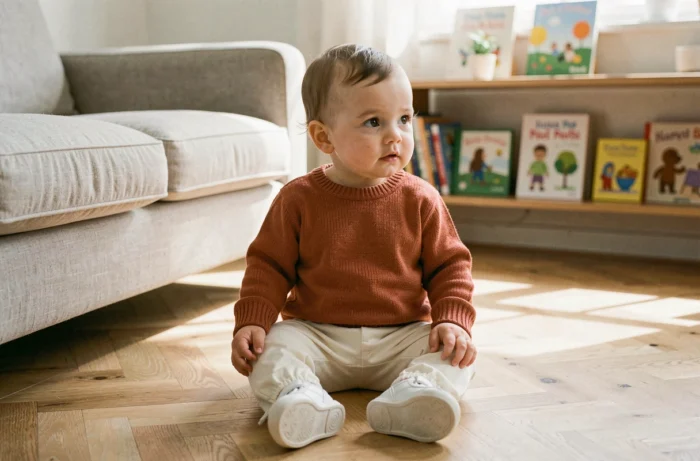
For style, prints, colors, and trendy cuts are now available on pieces as functional as a crossover bodysuit or snap-overalls. There’s no longer a need to choose between a practical outfit and one with character.
How Many Clothes to Plan for Each Size
An infant changes several times a day. For each size range worn, a sufficient rotation is needed to last between two washes. Six to eight bodysuits, five to six pajamas, and two or three daytime outfits cover a week without stress. Buying in bulk for a single size is rarely cost-effective: a baby can skip an entire size in just a few weeks.
Opting for a reduced stock per size and renewing as growth occurs allows for testing different brands and fits. It’s also an opportunity to incorporate second-hand items, which often offer barely worn pieces for a fraction of the new price.
Dressing a baby is less about fashion and more about observation: room temperature, skin sensitivity, growth rhythm. A well-chosen garment is one that can be put on in thirty seconds, withstands washing without losing shape, and allows the baby to move freely. Style comes afterward, and it comes easily when the foundation is solid.