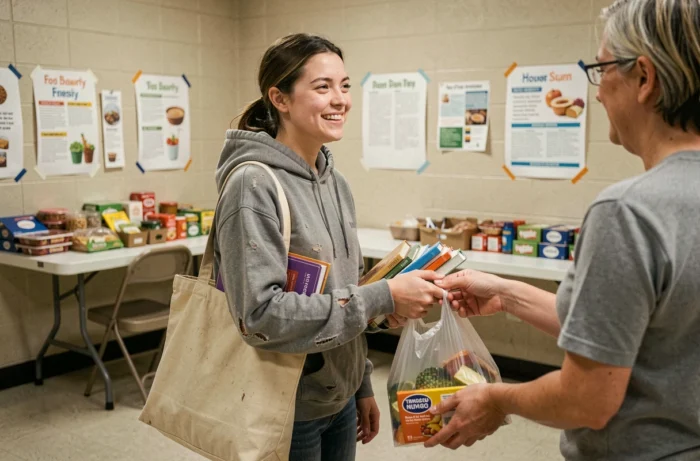
A student who skips meals several days a week is not looking for a speech on equal opportunities. They are looking for a food package, rent assistance, or psychological support that is accessible without delay. Student precariousness in France affects an increasing portion of the university population, and responses are being built today at several levels, between recent public measures and grassroots associative initiatives.
Student food assistance: a new flat-rate payment system
Since the law of April 13, 2023, a specific aid finances meals for students who do not have access to a CROUS university restaurant at a moderate price. The mechanism has been thoroughly revised by successive decrees, the latest dating from July 2026.
The main change concerns the payment method. The aid is no longer monthly but paid in two flat rates, covering the periods of September-January and February-June, via a dematerialized payment card managed by the Agency for Services and Payment.
The amounts set by decree are 20 euros per month for non-scholarship students and 40 euros for scholarship students, with a bonus of 10 euros per month for overseas students (Guadeloupe, Guyana, Mayotte, Martinique, La Réunion). Notably: this aid is granted regardless of the student’s resources, which distinguishes it from most traditional social measures.
On the ground, feedback varies on this point: some non-scholarship students discover late that they are entitled to it, due to a lack of information at their institution. Associations like those referenced on solidariteetudiante.fr guide beneficiaries towards these little-known aids, in addition to their own distributions.

Food distributions and mentoring: what associations are doing against student precariousness
Associative structures do not limit themselves to distributing packages. They cover a wide spectrum, from food to hygiene products, as well as access to rights and support towards employment.
Cop1, present in 23 cities, distributes about 130,000 baskets per year with a network of 4,500 volunteers. The model is based on weekly distributions open to any student in difficulty, without prior resource conditions.
Other initiatives take a different angle. Studhelp connects students with mentors who directly fund food donations. Their internal figures reveal a stark reality:
- The majority of their beneficiaries report skipping meals for financial reasons
- The remaining amount after rent and expenses often falls below 300 euros per month
- A significant portion of supported students have received no help from their institution in finding an internship or job
Individual mentoring fills a gap that public aids do not cover: the human connection, personalized follow-up, responsiveness to a specific emergency.
Housing and student APL: a concrete threat to budgets
Housing represents the largest expense for most students. APL (personalized housing assistance) serves as a direct safety net for rent, sometimes the only lever that makes a studio affordable.
The removal of APL for about 200,000 students has been mentioned in recent budget discussions. If this measure were to be implemented, it would primarily hit students in private housing outside CROUS residences, those who already do not have access to the moderate rents of the university housing stock.
Bordeaux Métropole has launched a call for projects selecting 15 associations to support vulnerable youth, including housing assistance measures. This type of local initiative shows that local authorities are stepping in where national mechanisms are slow or retreating.
Cost of student life: a record at the start of the 2026 academic year
The overall cost of student life has reached a new record this academic year, according to union surveys and published barometers. UNEF points to a chronic disinvestment by the state in higher education, which translates into rising ancillary costs (health insurance, transportation, supplies) without proportional increases in scholarships.
The norm is becoming precariousness, summarized the general secretary of UNEF in a recent intervention. This phrase reflects a shift: we are no longer talking about isolated cases but about a condition shared by a large fraction of the student population.

Mental health and access to care: the blind spot in student support
Financial precariousness generates cascading effects on health. Chronic fatigue, stress from juggling studies and work, social isolation: these factors contribute to a deterioration of mental health that university services struggle to absorb.
Free psychological consultations offered by some institutions or through programs like MonPsy remain insufficient in volume. Waiting times discourage students who need quick follow-up, especially during exam periods.
- Grassroots associations are increasingly integrating psychological support into their services
- Some student mutuals offer consultations at reduced rates, but information circulates poorly
- Students with disabilities face compounded difficulties in accessing care and appropriate financial assistance
An effective support system combines material aid and comprehensive support, not just a check or a food basket. The structures that work best on the ground are those that combine food distribution, access to rights, and referral to health professionals.
Student precariousness will not be resolved by a single mechanism. Flat-rate meal assistance, associative distributions, defense of APL, and access to care form a whole where each link matters. When one falters, the others compensate, up to a certain point. Students who succeed are generally those who have found the right combination of aids at the right time, often thanks to a local association that was able to guide them.