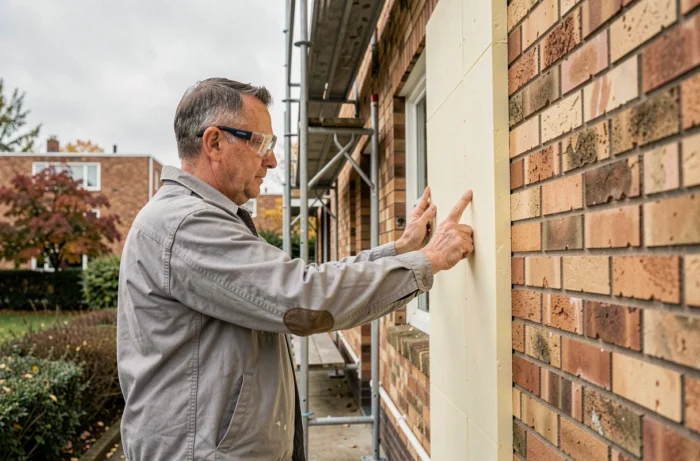
The energy renovation of buildings in France is going through a paradoxical phase. Regulatory obligations are tightening, DPE labels now condition rental agreements, and public aid exists. However, the volume of funded projects has significantly declined since 2025. Understanding where the gaps lie between different energy renovation solutions allows for targeting interventions that produce a real effect on consumption.
MaPrimeRénov’ 2026 Assessment: A Quantified Decline That Changes Strategy
Data from the first half of 2026 published by Argile reveals a significant drop in the MaPrimeRénov’ scheme. The number of large-scale renovation applications has fallen by about 78 % compared to the same period in 2025.
The total aid granted through MaPrimeRénov’ has decreased by about 26 %, or nearly 500 million euros less than in 2025. The number of homes actually funded in the supported pathway has declined by about 22 % year-on-year.
This decline is not trivial. It means that homeowners considering renovations must recalibrate their approach: focus on better-calibrated isolated actions or anticipate the administrative delays of a more selective supported pathway. Before choosing between insulation, heating replacement, or ventilation, this budget constraint must be integrated into the decision-making timeline. A comprehensive overview of energy renovation solutions for buildings helps prioritize actions based on their actual yield.

Insulation, Heating, Ventilation: Comparison of Renovation Work Categories
Not all work categories produce the same effect on a home’s energy performance. The table below summarizes the characteristics of each intervention based on data available in reference guides (France Rénov’, ANAH).
| Work Category | Impact on Consumption | MaPrimeRénov’ 2026 Eligibility | Main Constraint |
|---|---|---|---|
| External Wall Insulation | Major reduction in thermal losses | Yes (isolated action and supported pathway) | High cost, permission in heritage areas |
| Attic Insulation | Significant reduction (the roof is the primary source of loss) | Yes | Accessibility of the attic, thickness of insulation |
| Window Replacement | Moderate if done alone | Yes (under conditions) | Limited effect without opaque wall insulation |
| Air/Water Heat Pump | Significant reduction in heating bills | Yes, but exclusion of hybrid fossil heat pumps since September 2026 | Sizing, compatibility with existing network |
| Controlled Mechanical Ventilation (CMV) Double Flow | Improvement in comfort and reduction of losses through air renewal | Yes (as part of a supported pathway) | Space taken by ducts, regular maintenance |
Window replacement, often seen as a priority, produces a limited effect if not coupled with wall insulation. Losses through opaque walls (walls, roof) represent a much larger share than those through glazing.
Hybrid Fossil Heat Pumps Excluded Since September 2026
The tightening of regulations on fossil heating changes the situation for homeowners considering a hybrid heat pump combining a heat pump and a gas boiler. Since September 2026, these systems are no longer eligible for MaPrimeRénov’. Only heat pumps not linked to fossil energy remain in the scheme.
This change pushes towards all-electric solutions or connections to a heat network where available. For tertiary buildings subject to the tertiary decree, this constraint adds to the obligations for gradual reductions in energy consumption.
Renovation by Action or Supported Pathway: Where Does the Performance Gap Lie?
MaPrimeRénov’ offers two distinct approaches. Renovation by action finances an isolated intervention (insulation, heating replacement). The supported pathway aims for a leap of several DPE classes by combining multiple works.
- Renovation by action is suitable for homes classified D or E needing only one failing category. It remains accessible without a Rénov’ supporter, but its effect on the DPE label is often limited to one class.
- The supported pathway targets energy sieves (F and G) with a goal of gaining at least two classes. It requires the use of a certified Mon Accompagnateur Rénov’ supporter and a prior energy audit.
- The co-ownership pathway (MaPrimeRénov’ Copropriété) finances works on common areas, allowing for a coherent treatment of the building envelope, a lever often underutilized.
The supported pathway produces significantly higher performance gains, but it is also the one whose applications have declined the most in 2026. Administrative complexity and the remaining costs after aid hinder households, particularly those with intermediate incomes.
Tertiary Decree and Professional Buildings: Obligations Distinct from Residential
Tertiary buildings over 1,000 m² are subject to the tertiary decree, which imposes a gradual reduction in final energy consumption. The deadlines set reduction milestones relative to a reference year chosen by the operator.
The levers are not only technical. Raising occupant awareness and managing equipment (technical building management, hourly regulation) generate measurable savings without heavy works. However, to achieve the most ambitious milestones, insulation of the envelope and replacement of heating and cooling systems become inevitable.
Climate Adaptation: A Parameter Absent from Previous DPEs
The SNBC 3 (National Low Carbon Strategy, third version) accelerates the decarbonization trajectory of buildings. The new guide published by the Architects of Buildings of France now incorporates climate change adaptation into recommendations for heritage buildings. Renovating a building without anticipating summer comfort amounts to addressing only half the problem.
Solar protections, cross-ventilation, and the thermal inertia of materials become selection criteria on par with the thermal resistance of insulation. This dimension remains poorly integrated into standard quotes from RGE artisans, justifying an energy audit that takes into account climate projections and not just winter consumption.
The decline in public aid in 2026 does not make energy renovation less relevant. It makes the choice of work categories more decisive. Prioritizing insulation of opaque walls, checking the eligibility of equipment after the exclusions of September 2026, and integrating summer comfort from the project’s design: these three decisions condition the actual return on investment of a renovation.