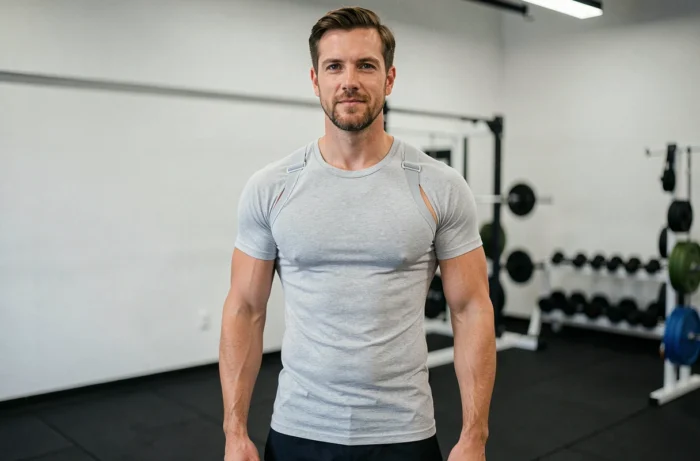
The Percko t-shirt sold at Decathlon is presented as a passive assistance postural garment, equipped with patented tensors designed to realign the spine. Between the enthusiastic feedback from some users and the limitations pointed out by health professionals, the question deserves to be asked from the perspective of the available data. This test reviews what the product actually offers, what it corrects, and where it reaches its limits.
Patented Percko Tensors: What the Technology Changes Compared to a Classic Corrector
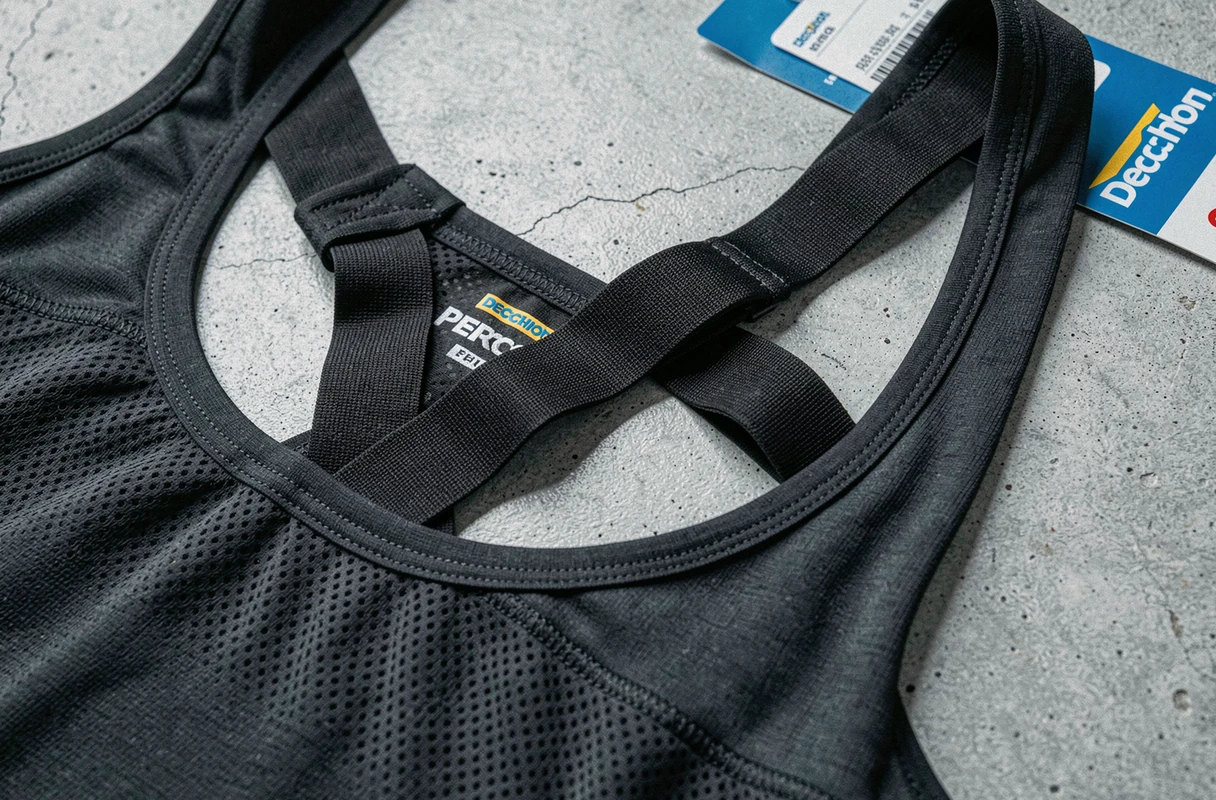
Most posture correctors on the market work through mechanical constraint. They pull the shoulders back using elastic straps, forcing a position without engaging the back muscles. The Percko t-shirt is based on a different principle: patented tensors integrated into the fabric, positioned at the shoulders and lower back.
These tensors aim to open the chest and stimulate an active posture. The wearer feels a slight pull that reminds them of the correct position, without blocking movement. This distinction places the Percko in the category of passive assistance postural garments, halfway between classic textiles and orthoses.
For a detailed review of the Percko Decathlon t-shirt regarding the wearing experience, several sources confirm a “second skin” effect that does not hinder under everyday clothing. The fabric remains discreet, which clearly differentiates it from visible corrective harnesses under a shirt.

Posture Corrector Comparison: Percko T-shirt, Classic Harness, and Lightweight Exoskeleton
To situate the Percko in its market, it is useful to compare three categories of postural solutions based on concrete criteria.
| Criterion | Percko T-shirt | Classic Corrective Harness | Lightweight Exoskeleton |
|---|---|---|---|
| Action Principle | Integrated tensors, passive assistance | Elastic straps, mechanical constraint | Rigid or semi-rigid structure, active support |
| Discretion Under Clothing | High (t-shirt appearance) | Low (visible straps) | Very low |
| Muscle Engagement of the Back | Yes (postural reminder) | No (the harness does the work) | Variable by model |
| Recommended Use | Light daily tasks, office | Short rehabilitation sessions | Handling, prolonged effort |
| Long-Term Muscle Autonomy | Encouraged | Risk of dependency | Neutral to encouraged |
This table highlights a often overlooked point: the Percko stimulates muscle activity instead of replacing it. A classic harness, worn too long, can weaken the paravertebral muscles. The postural t-shirt acts as a permanent proprioceptive signal.
On the other hand, for contexts of prolonged effort or repetitive handling, recent comparative guides on exoskeletons clearly position the Percko as a prevention-oriented solution, not heavy rehabilitation.
User Feedback on Percko: What Reviews Reveal Over Time
Certified reviews on specialized platforms outline a fairly consistent user profile. Positive feedback consistently mentions three elements:
- A reduction in tension in the upper back noticeable after a few days of regular use, especially among people working seated
- A postural reminder effect described as natural, without a sensation of rigidity or respiratory discomfort
- A manufacturing quality deemed acceptable for a garment worn daily, with durability of the fabric and tensors over time
Negative reviews, fewer in number, point out two recurring limitations. The first concerns the choice of size, crucial for the effectiveness of the tensors. A t-shirt that is too large loses much of its reminder effect. The second pertains to expectations: some users hope for immediate relief from chronic pain, which the product does not claim to offer.
Osteopaths who have tested the product acknowledge a possible complementarity with therapeutic follow-up. Their reservation concerns a specific point: the t-shirt does not correct an established pathology, it supports a posture already in the process of improvement.
Percko Postural T-shirt in Daily Life: Occasional Use or Extended Wear
The debate has shifted in recent months. The question is no longer whether the Percko “works,” but under what conditions it provides measurable benefits.
Recent content on the subject converges towards a clear distinction. For light daily tasks (office work, driving, household chores), the t-shirt fulfills its role as a postural reminder. The wearer eventually integrates the correct position without thinking about it, which is the real goal of the product.
In contrast, for intensive sports use or repetitive handling sessions, the benefits seem limited. The Lyne Pro model, designed for professional environments, offers more marked support but remains in the prevention category.
- Office and remote work: relevant use, wearing for several consecutive hours well tolerated
- Light sports (walking, yoga): some users appreciate the postural reminder during effort
- Intense effort or handling: other solutions (lightweight exoskeletons) are more suitable
The model sold through Decathlon corresponds to the Lyne Up, the most versatile in the range. Its positioning in a public distribution network confirms that it targets a daily preventive use, not a population suffering from severe spinal pathologies.
The Percko t-shirt is neither a medical revolution nor a gadget without effect. The patented tensors produce a postural reminder documented by users and health professionals. Its limit lies in its scope of action: prevention and comfort in daily life, not treatment for chronic low back pain. For a buyer looking to gradually correct their posture without wearing a visible medical device, the product fulfills a role that neither a harness nor a simple technical t-shirt can cover.