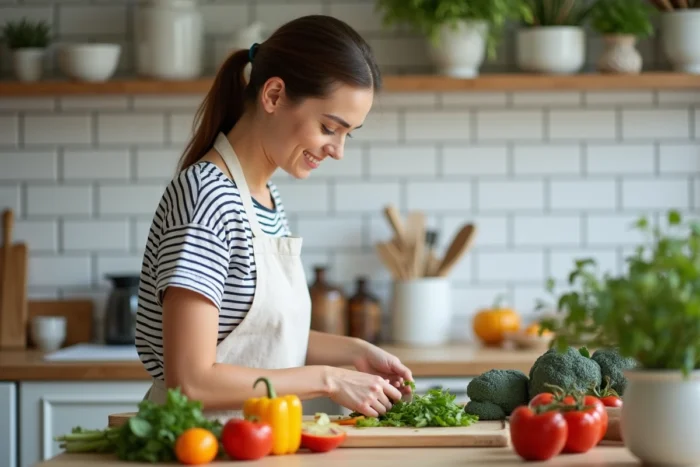
Cooking on a daily basis presents a concrete problem for most households: finding recipe ideas, managing available ingredients, and producing satisfying meals without spending the entire evening on it. Cooking assistance formats have multiplied in recent years, including ready-made weekly menus, batch cooking, and functional snacking. The question remains which of these actually deliver on their promises when faced with the reality of a half-empty fridge on a Tuesday evening.
Batch cooking and weekly menus: what these formats really change
Generalist French websites like Journal des Femmes and CuisineAZ now systematically publish structured weekly menus with ingredient lists, preparation order, and a mix of cold and hot dishes. The principle is simple: concentrate shopping and part of the cooking into a single session, often on Sunday, to free up the rest of the week.
This model works well for households with a regular rhythm. It assumes blocking off two to three hours of preparation at once, having a sufficiently large refrigerator, and tolerating eating reheated dishes several nights in a row. Feedback on this point varies: some find that the texture of vegetables degrades after two days, while others swear by this organization.
For those who want to structure their meals without starting from scratch every week, discovering cooking with Easy Cooking provides access to recipes designed for everyday life, categorized by difficulty level and preparation time.
Batch cooking also has its limits: it favors dishes that keep well (casseroles, soups, grains) and overlooks crunchy salads, fish, or quick-cooking options. A fixed menu does not adapt to unforeseen circumstances, whether it’s an impromptu aperitif or a leftover zucchini to use up.
Everyday recipes: better to choose ingredients than techniques
Most content on cooking tips focuses on technical gestures: sharpening a knife, deglazing a pan, achieving al dente cooking. These skills have their place, but they do not help solve the everyday problem, which is primarily about ingredient choice.
A successful dish relies first on the quality and compatibility of what goes into it. Three well-matched ingredients yield a better result than a complex recipe made with average products.
Building a dish from what you have
Rather than searching for recipe ideas and then going shopping, the reverse approach is gaining ground: starting from what’s in the fridge and pantry to compose a meal. This logic requires mastering a few basic combinations:
- A starch (pasta, rice, potatoes, bread) as the caloric base of the meal, cooked in large quantities to reuse part of it the next day in a salad or casserole
- A seasonal vegetable (zucchini, tomato, bell pepper, cabbage) that adds texture, color, and freshness, prepared simply: roasted in the oven, sautéed in a pan, or raw in a salad
- An element of concentrated flavor (grated cheese, soy sauce, mustard, fresh herbs, lemon) that transforms a bland dish into a tasty one without adding complexity
Seasoning does more than cooking technique for the final result. Salt, fat, and acidity are the three levers that make a dish satisfying. A drizzle of vinegar or lemon juice over roasted vegetables radically changes the taste.
Functional snacking: an alternative to cooked meals
The food service and agri-food sectors are developing in 2026 snacks designed for energy and recovery, rich in fiber, protein, and probiotics for the microbiome. Functional snacking differs from classic nibbling by its targeted nutritional composition.
Protein bowls, legume wraps, fermented yogurts, or superfood snacks provide quick solutions that allow for healthy eating without advanced cooking skills. For days when cooking a real meal is not feasible, these options fill a gap that traditional recipes do not cover.
When snacking replaces a meal
The trap would be to consider these snacks as complete meals in the long term. A wrap or a bowl does not always provide the balance of a structured meal with a starter, main course, and side. However, when integrated occasionally into the week, functional snacking lightens the mental load associated with meal planning.
The long-term nutritional impact of these new formats remains to be documented by specific studies. What is observable is that their growing popularity reflects a real need: to eat properly without every meal requiring a cooking session.
Meal ideas and pleasure at the table: breaking the recipe-chore cycle
The word “pleasure” often comes up in discussions about everyday cooking, but it masks a gap. For many, cooking remains a logistical constraint, not a leisure activity. Transforming this constraint requires reducing friction rather than multiplying ambitions.
Some concrete principles help rediscover pleasure without pressure:
- Limit the number of different dishes in the week to four or five, accepting to eat the same meal twice in a slightly modified form
- Set aside one evening a week for a no-cook meal (snack platter, topped bread, composed salads) to break the routine
- Choose one new dish per week and test it without stakes, on an evening when a plan B exists
Reducing the number of culinary decisions per week decreases mental fatigue more effectively than any technical trick. A rotation of ten mastered recipes, adjusted according to the season, covers most of a household’s needs.
A simple, well-seasoned meal made from fresh ingredients remains more satisfying than an elaborate dish made from mediocre products. Ten solid recipes and a well-stocked pantry of condiments are enough to cover most weeks.