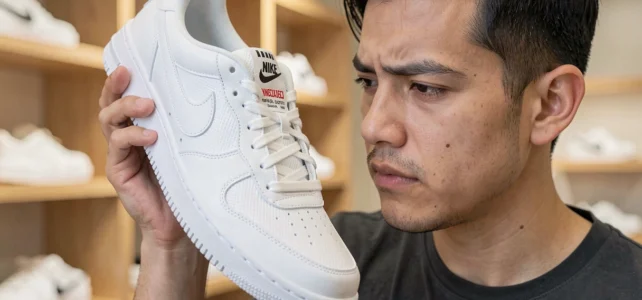
Each pair of Nikes carries several identifiers printed on the inner label and on the box: a style code (or SKU), a UPC/EAN barcode, and, on recent models, a QR code. These codes serve to identify the model, colorway, and size. Before making any purchase on the secondary market, knowing how to read and cross-reference these identifiers remains the most reliable reflex to spot a counterfeit.
Nike Style Code: Anatomy of a Often Misunderstood Identifier
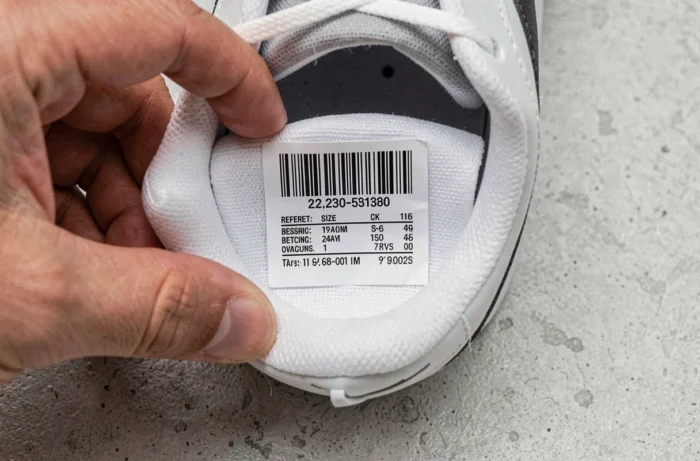
The style code is an alphanumeric sequence in the format XXX-YYY, visible on the label sewn inside the shoe (usually on the tongue or under the collar). The first part designates the model, while the second indicates the specific colorway.
A rarely emphasized point: there is no official public Nike registry to verify a style code. Third-party sites that offer to “check” a SKU only cross-reference community databases, which are fed by users. Their reliability thus depends on the completeness of these databases, not on validation by the manufacturer.
To properly utilize this code, the method is to enter it into a search engine and compare the results with the corresponding product page on Nike.com. If the style code leads to a colorway or model different from the one you have in hand, the alert is immediate. Before finalizing a purchase, taking the time to check the Nike product code on the label and on the box helps eliminate a good portion of blatant counterfeits.
Nike UPC/EAN Code: An Indicator with Limited Reliability
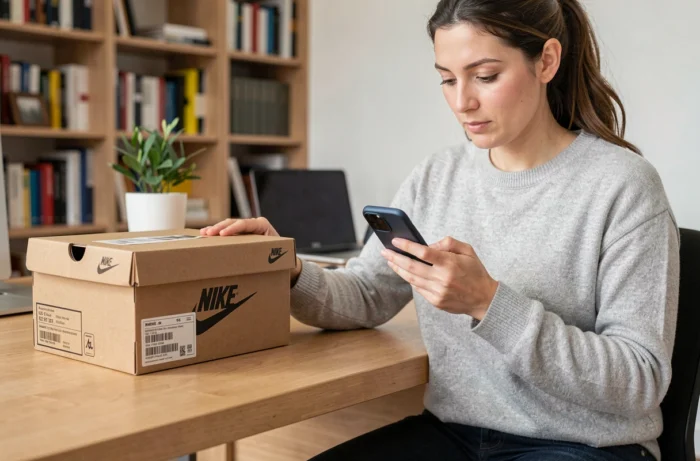
The UPC code (in the United States) or EAN (in Europe) is the classic barcode printed on the box and on the inner label. It encodes the product, size, and sometimes the destination market.
The most well-known verification involves scanning this barcode with a reading app, then checking that the displayed product matches the model in hand. An additional step involves the GEPIR (Global Electronic Party Information Registry) database, which allows you to verify that the prefix of the barcode is indeed assigned to Nike Inc.
Why UPC Alone is No Longer Sufficient
Next-generation counterfeits replicate valid UPC codes copied from authentic pairs. A correct barcode does not guarantee the authenticity of the shoe. It only confirms that the number exists in the Nike circuit, not that the pair in front of you comes from an authorized factory.
The only way to leverage the UPC is to cross-reference it with other elements: matching the size indicated on the inner label with that encoded in the barcode, consistency of the style code, and the overall condition of the print (font, spacing, sharpness).
Nike QR Code and NFC Chip: Scanning Does Not Mean Authenticating
On models released in recent years, Nike integrates a QR code on the inner label, and sometimes an NFC chip in the sole or tongue. The natural reflex is to scan the QR code thinking it will provide a confirmation of authenticity.
A QR code alone no longer proves the authenticity of a pair of Nikes. Some counterfeits now include fake QR codes or NFC chips that link to generic pages, with no connection to a specific product page.
The best practice is to scan the QR code exclusively via the official Nike app. If the scan leads to a detailed Nike product page (model, colorway, size), that’s a positive signal. If the link leads to an empty page, a 404 error, or a third-party site, the pair is suspicious.
- Scan the QR code with the Nike app, not with a generic reading app, to ensure the redirection points to nike.com.
- Compare the model displayed on the Nike page with the style code on the physical shoe label.
- Check the consistency of the size: the size on the label, on the box, and in the QR data must match exactly.
Cross-Referencing Method: Checks to Combine Before a Purchase
No code taken in isolation allows for a conclusion. Cross-referencing at least three identifiers remains the only reliable method to reduce risk. The principle is simple: each piece of data printed on the pair must be consistent with all the others.
- The style code on the inner label must match the style code on the box label and designate the correct model/colorway on nike.com.
- The UPC/EAN code must encode the correct size and point to Nike Inc. in the GEPIR database.
- The QR code, scanned via the Nike app, must link to the exact product page, not to a generic page.
- The typography of the inner label (font, alignment, spacing between characters) must be clear and consistent. Counterfeits often reveal irregular letter spacing or a slightly different font.
The Trap of the Mismatched Box
On the secondary market, some authentic pairs are resold in a box that is not theirs. In this case, the style code on the box does not match that of the inner label. This inconsistency does not automatically mean counterfeit, but it should prompt a closer examination of all other checkpoints.
When a seller refuses to provide a clear photo of the inner label or the box label, the lack of transparency is a warning signal in itself. A legitimate seller has no reason to hide this information.
Sneaker counterfeiting is becoming more sophisticated each year. Identically reproduced codes, functional QR codes, and well-crafted boxes make detection more demanding. The only lasting defense remains the method: verify each identifier, cross-reference them, and purchase from channels with documented traceability.