
A mass converter is not meant to simplify cooking. It serves to correct the fundamental mistake that most recipes make: confusing volume and weight. When a recipe states 250 ml of flour, the result in grams can vary by more than 30% depending on whether the flour is sifted, packed, or simply poured. Using a mass converter tailored to each ingredient removes this variable and stabilizes the results, both in baking and savory cooking.
Density by ingredient: the parameter that basic converters ignore
The majority of online converters apply a universal rule of three, as if all ingredients had the same density as water. This approach works for milk or vinegar, but it produces notable discrepancies with fats, powders, and syrups.
Oil is lighter than water: it floats. At equal volume, its mass is therefore lower. Honey, on the other hand, is significantly heavier. A reliable converter incorporates the actual density of each ingredient, not a generic ratio.
Recent tools like Kitchen Converter from Dancing Macaw calculate masses based on the “specific gravity” unique to each product. This type of internal density profile reduces approximations in sensitive recipes. We recommend checking, before any use, that the chosen converter offers a catalog of differentiated ingredients, and not just a free field to enter a volume.
For beginners who want to understand the logic behind these tools, there is a user guide on Mon Blog Cuisine that details each step of the conversion process.
Converting cups and ounces to grams: the pitfalls of the imperial system
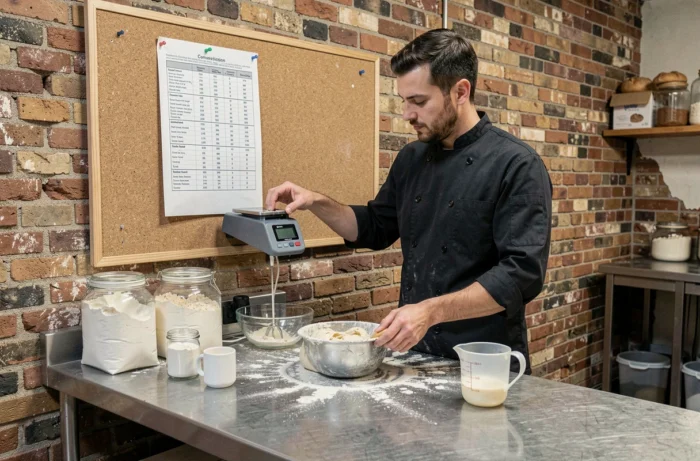
Anglo-Saxon recipes use cups, tablespoons, and ounces. The problem does not come from the calculation itself, but from the floating standardization of these measurements. An American cup does not exactly correspond to an Australian cup, and the distinction between fluid ounces and mass ounces (avoirdupois) regularly traps French-speaking cooks.
Here are some useful guidelines to keep in mind:
- 1 ounce (avoirdupois) corresponds to 28.35 g, which is the standard used by almost all online converters.
- 1 pound equals 0.45 kg, a common conversion for meats and fish in North American recipes.
- 1 cup of flour does not weigh the same as 1 cup of sugar: the mass directly depends on the density of the ingredient, not the container.
A proper mass converter provides an “ingredient” field before the calculation. If the tool does not ask which ingredient you are converting, it applies a default water ratio. The result will be correct for an aqueous liquid, but incorrect for flour, melted butter, or cocoa powder.
Adjusting quantities by number of servings: when the coefficient is not enough
Multiplying all ingredients by a linear coefficient is a mistake in baking. Yeasts, gelatins, and certain thickeners do not behave proportionally when doubling or tripling a recipe. A converter that recalculates servings without distinguishing ingredient categories introduces a silent bias.
Recently released applications, like Recipe Measure, combine mass/volume conversion with automatic quantity adjustment for a given number of servings. This is beneficial for basic ingredients (flour, sugar, liquids). However, we recommend always manually adjusting leavening agents and gelling agents after the automatic calculation.

The same caution applies to seasonings. Doubling the amount of salt or spices when doubling the number of guests often results in a dish that is too seasoned. The adjustment coefficient works on structural masses, not on seasoning masses.
Quick check with a measuring cup
The graduated measuring cup remains a useful complement, provided you know its limits. A 250 ml cup allows you to measure a volume, not a mass. If your converter indicates that 100 g of powdered sugar corresponds to about 179 ml, the measuring cup makes perfect sense to verify the result without a scale.
This double-checking (digital converter + physical measurement with a cup) is particularly relevant when working with ingredients whose granularity varies from brand to brand, such as chestnut flour or almond powder.
Choosing the right mass converter based on your cooking practice
Not all converters meet the same need. A static equivalence chart is sufficient for everyday cooking with common ingredients. As soon as the recipe includes products with variable density or imperial units, a dynamic tool becomes necessary.
Selection criteria for a suitable converter:
- The ingredient catalog should cover at least flours, sugars, fats, common liquids, and cocoa powders. A tool limited to ten products will be insufficient for baking.
- The conversion should work both ways (mass to volume and volume to mass), with simultaneous display in grams, milliliters, and imperial units.
- Adjustment by number of servings is a plus, provided the tool allows locking certain ingredients (yeast, gelatin) for separate adjustments.
- Mobile compatibility has become a non-negotiable criterion, as most conversions are done with a tablet or phone in hand, facing the work surface.
Applications like Tare: Kitchen Companion focus on “density-aware ingredient conversion” and integrate these features into an interface designed for use with hands in flour. This type of tool represents a measurable time-saving compared to a printed chart stuck on the refrigerator.
The choice between a web converter and a native application depends on the frequency of use. For occasional conversion, a site with a good ingredient catalog is sufficient. For regular practice, a dedicated app with integrated density profiles avoids back and forth between the browser and the recipe.
The accuracy of a mass converter does not replace understanding the mechanism. Knowing why 100 g of flour does not occupy the same volume as 100 g of sugar is what allows you to spot an aberrant result before it ends up in the mixing bowl.