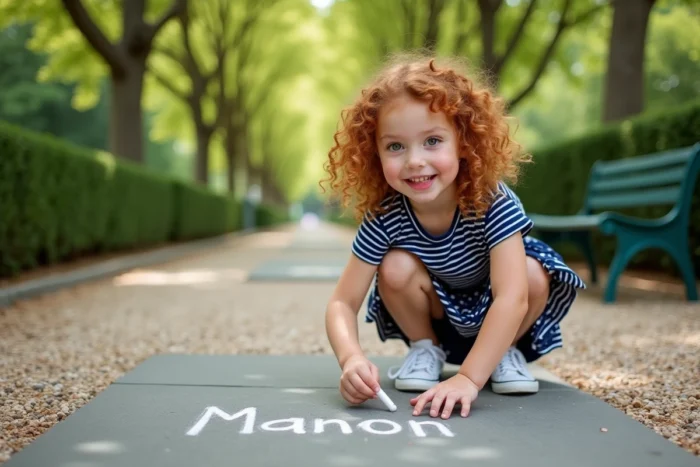
Manon is among the most commonly given female names in France since the end of the 20th century. An affectionate diminutive of Marie, it has a Hebrew etymology linked to Myriam, with meanings ranging from “she who raises” to “beloved” according to various sources. Its feast day is celebrated on August 15, the day of the Assumption.
Manon, a generational name rather than a timeless one
Name websites often present Manon as a classic French name that transcends time. The statistical reality tells a different story. The average age of people named Manon is around 20 years, which means that the vast majority of Manons were born within a fairly narrow time frame, concentrated around the 1990s and 2000s.
This profile is that of a generational name, not a timeless name like Marie or Jeanne, whose distribution spans several decades or even centuries. Manon experienced a rapid rise, a massive peak, and then a sharp decline.
To better understand the popularity of the name Manon in France, one must look at recent birth curves: in 2024, about 520 newborns were given this name, a figure that remains respectable but is far from the peak reached in the 1990s.
Even more striking: Mira reports a decline of -64% in 2024 for Manon. The decline is not gradual; it is accelerating. The name has fallen out of the top 100 and is sliding into a zone where it represents only a marginal fraction of annual births.
Etymology of the name Manon: a less simple origin than it seems
Manon is generally presented as a diminutive of Marie, which itself is derived from the Hebrew Myriam. This lineage is widely accepted. However, the precise meaning of Myriam remains debated among linguists and onomastics specialists.
According to sources, there are at least three distinct interpretations:
- “She who raises,” referring to a Hebrew root related to elevation or greatness
- “Beloved” or “well-loved,” an interpretation often linked to an Egyptian root (mry)
- “Drop of the sea” (stilla maris), a medieval Latin reading that circulated for a long time but which modern etymologists consider a distortion
The etymology of Manon is therefore not completely stabilized. Competing pages generally choose a single version and present it as definitive. Caution requires acknowledging this plurality of interpretations.
What is certain is the Provençal and French anchoring of the diminutive itself. Manon was formed by adding the suffix -on to “Man-,” an affectionate contraction of Marie or Marianne, according to a common mechanism in the dialects of southern France.
Geographical distribution of Manon: a very French name
Unlike names like Emma or Léa, which have a wide international distribution (English-speaking countries, Scandinavia, Germany), Manon remains a name with a predominantly French grounding. It can be found occasionally in French-speaking Belgium and Switzerland, but its distribution outside the Francophonie remains very limited.
This specificity is partly explained by its sound. The suffix -on, perceived as feminine in French, does not function the same way in other languages. In English or German, it does not spontaneously evoke a female name, which hinders its export.
Cultural anchoring also plays a role. Manon owes part of its notoriety to French literary and cinematic works: Manon Lescaut by Abbé Prévost, Manon des Sources by Marcel Pagnol and later by Claude Berri. These references, very well-known in France, do not have the same resonance abroad.

Manon after the peak: what happens to a declining name
A name that falls in rankings does not disappear. It changes status. Manon shifts from the “trendy name” category to the “dated name” category, meaning a name that immediately places its bearer in a specific age group.
This phenomenon is well documented for other French names. Sylvie evokes the 1960s, Nathalie the 1970s, Aurélie the 1980s. Manon joins this list for the 1990s-2000s.
Will the name make a comeback in twenty or thirty years, driven by a sense of nostalgia, as is the case for some retro names (Louise, Léontine, Marguerite)? The available data does not allow for a conclusion on this point.
Names that return after a cycle of obsolescence are generally those with a long pre-modern history. However, Manon, as an autonomous name (and not just a simple nickname), only appears massively in civil registry records from the 1980s. Its profile as a recent name makes a “retro” comeback less likely than for names that have been in use for several centuries.
Cultural significance and personality associated with Manon
Name websites often attribute character traits to Manon: gentleness, sensitivity, determination. These descriptions are more a matter of popular tradition than of verifiable analysis. No scientific study establishes a link between a name and innate personality traits.
What is more interesting is the cultural weight of the name. Manon Lescaut embodies destructive passion in Abbé Prévost’s novel. Manon des Sources, in Pagnol’s work, represents justice and attachment to the Provençal land. These two literary figures have contributed to giving the name a blend of sweetness and strength.
The song Manon by Jean-Jacques Goldman also contributed to the name’s popularity in the 1980s, a period when its popularity curve begins its ascent.
Manon remains a name whose trajectory perfectly illustrates the fashion mechanisms that govern name choices in France. Its Hebrew meaning gives it etymological depth, but it is indeed French popular culture that has shaped its demographic destiny.