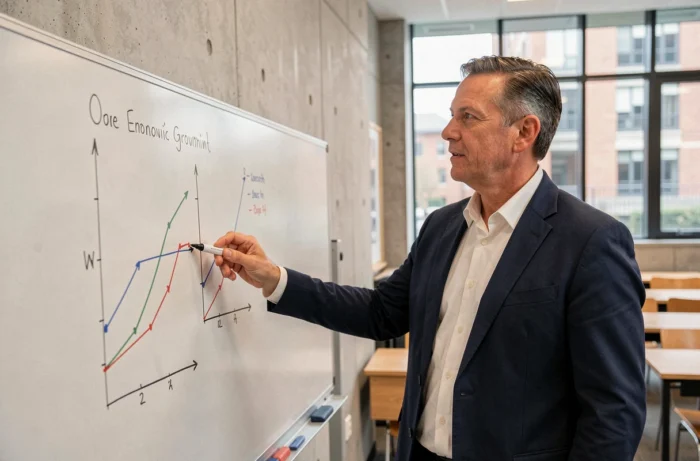
Economic growth measures the increase in the production of goods and services over a given period, typically via real GDP. Behind this generic term lie two distinct mechanisms: extensive growth, which relies on the addition of factors of production, and intensive growth, based on improving their efficiency. Understanding this distinction allows for a different reading of the economic trajectories of countries and the public policy choices that accompany them.
Residual factor and total productivity: what models really measure
When Robert Solow published his work in 1957, he estimated that most of the growth in the United States between 1909 and 1949 could not be explained by the increase in labor or capital. This residual, dubbed total factor productivity, became the central marker of intensive growth.
Edward F. Denison nuanced this observation a few years later, but his conclusions pointed in the same direction: a significant portion of growth escapes simple resource accumulation. This residual captures technical progress, work organization, worker training, and management quality.
This accounting approach remains the basis for distinguishing between extensive and intensive growth. It also poses a limitation: the residual is calculated by subtraction, meaning it aggregates everything that cannot be measured directly. Calling it “technical progress” sometimes amounts to naming our ignorance. Despite this methodological weakness, most international comparative analyses, including those of the OECD, rely on this decomposition.
To better understand the differences between extensive and intensive growth, it is essential to keep in mind that the boundary between the two depends on the measurement method chosen and the quality of available data.
Extensive growth: the role of labor and capital factors
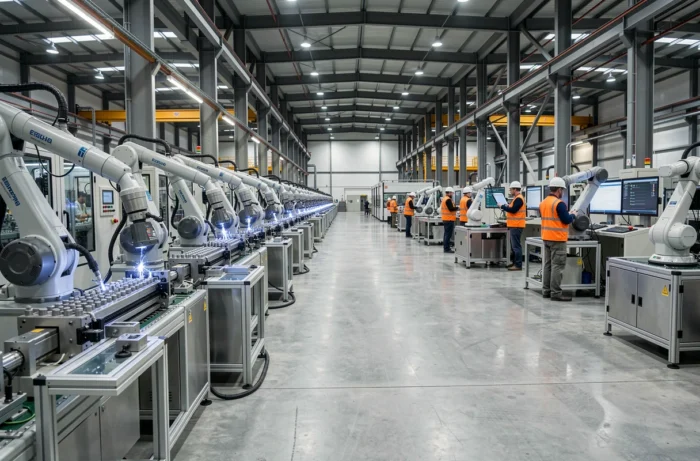
Extensive growth refers to an increase in production achieved by increasing the quantity of mobilized factors. More workers, more machines, more cultivated land. Production increases, but productivity per unit of factor remains stable or progresses little.
Several mechanisms fuel this type of growth:
- The increase in the labor force, through natural demographics or immigration, which provides additional labor volume without changing individual productivity.
- Investment in fixed capital (factories, infrastructure, equipment), which expands production capacity without necessarily changing methods.
- The extension of cultivated areas in agriculture or the extraction of natural resources, which increases the produced volume proportionally to the means engaged.
This model has characterized many phases of economic catch-up. As long as available resources are not fully exploited, extensive growth can generate high GDP growth rates. However, it faces a ceiling: diminishing returns eventually slow down the dynamics when each additional unit of capital or labor produces an increasingly smaller gain.
Intensive growth and productivity gains: the engine of technical progress
Intensive growth does not rely on the addition of factors but on their more efficient use. Producing more with the same resources, or producing the same with less: this is the principle of productivity gains.
Four determinants structure these gains. The qualitative accumulation of capital (replacing an old machine with a more efficient one). The organization of work, from task division to modern management methods. Technological progress, which alters production conditions. The elevation of education and skill levels, what economists call human capital.
The theory of endogenous growth, notably developed by Paul Romer and Robert Lucas, has extended this analysis by showing that innovation, research and development, and education are not external factors to the economic system. They are produced by investment choices, meaning public policies can influence the pace of intensive growth.
Structural slowdown in productivity: a warning signal for advanced economies
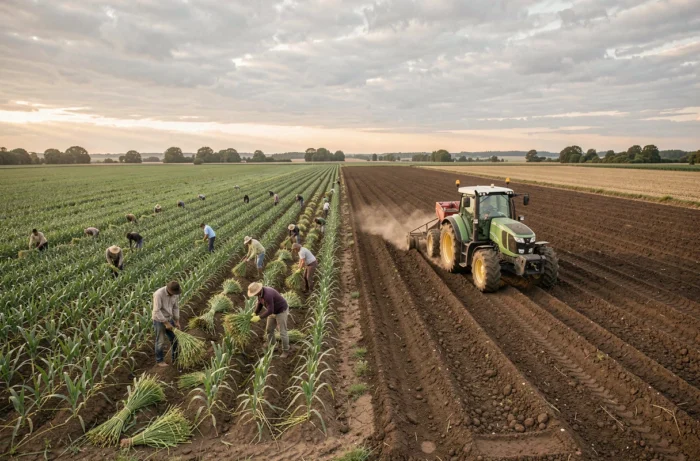
Academic definitions often present intensive growth as a powerful and sustainable lever. Recent reality tempers this picture. According to the OECD Compendium of Productivity Indicators 2026, labor productivity (GDP per hour worked) increased by about 1.2% in 2024 on average in the OECD, double that of 2023. This cyclical rebound masks an underlying trend: the median productivity growth remains significantly lower than that observed between 2001 and 2007.
This structural slowdown means that intensive growth is less dynamic than in the early 2000s in most advanced economies. Several factors have been put forward to explain this: uneven diffusion of digital technologies, aging of the labor force, suboptimal allocation of capital to low-productivity sectors.
For businesses, this trend has direct consequences. Relying solely on extensive growth (hiring, investing in volume) without improving process efficiency exposes them to margin compression. Organizational and technological innovation remains the main lever to counter this erosion, but its effects take time to materialize in productivity statistics.
Linking extensive and intensive growth in the ecological transition
The distinction between extensive and intensive takes on an additional dimension when applied to environmental issues. Purely extensive growth, based on increased resource consumption, comes into direct tension with the physical limits of the planet.
The notion of decoupling illustrates this point: some economies manage to increase their GDP while reducing their CO2 emissions within their territory. This decoupling largely relies on carbon intensity gains of GDP, in other words, on a form of intensive growth applied to energy use. However, this progress is partially offset by imported emissions related to goods produced elsewhere and consumed locally.
The ecological transition thus pushes for a rethinking of intensive growth beyond mere labor and capital productivity. It incorporates energy efficiency, resource use sobriety, and the capacity for innovation to reduce the environmental footprint per unit produced. This shift gradually redefines what it means to “produce better” within a framework of finite resources.
The boundary between extensive and intensive growth is not a simple academic classification exercise. It conditions companies’ investment choices, the orientation of public policies, and the sustainability of economic trajectories. The recent rebound in productivity in the OECD shows that intensive levers still work, but their structural weakening reminds us that no growth model can sustain itself without continuous technological and organizational renewal.